
How to Turn Your Website Into a Long-Term Business Asset
In all my years of experience working on websites, across companies, industries, and stages of growth, I’ve come to define website growth in a very specific way.
Website growth is not simply about increasing traffic. It’s not about vanity metrics or chasing short-term spikes. Website growth is the process of turning your website into a valuable business asset, one that actively supports your goals, compounds over time, and works for you even when you’re not actively managing it.
That shift in mindset is where real growth begins.
Before any tactics are implemented, before SEO audits or redesigns or content calendars, website growth requires clarity. What are you building your website for? What role should it play in your business? And what does success actually look like for you?
Without answers to those questions, growth efforts often feel scattered, reactive, or disappointing, no matter how much effort is involved.
Website Growth Starts With Clear Goals
True website growth starts by defining:
- What the website should achieve
- Who it should serve
- How it should support broader business objectives
Whether you’re a B2B company, a consultant, a personal brand, or a space-focused organization, your website should be intentionally designed to move the business forward. That intentionality is at the core of effective website strategy.
A website without strategy might still function, but it won’t grow in a meaningful or sustainable way.
Website Growth Is Not Just About Traffic
Traffic matters. People need to visit your website in order for it to grow. But growth is not measured by visitor counts alone.
If your website attracts the wrong audience, people who don’t understand your offer, don’t need your solution, or aren’t ready to engage, then increased traffic can actually slow growth instead of accelerating it.
Website growth is about attracting the right people, not just more people.
That means:
- Understanding who your ideal visitors are
- Knowing what problems they’re trying to solve
- Creating content and experiences that speak directly to those needs
This is where website consulting becomes especially valuable. An experienced consultant doesn’t just look at analytics, they look at alignment between audience, messaging, structure, and goals.
The Five Website Growth Foundation Components
Sustainable website growth doesn’t happen by chance. It’s built on a small number of foundational components that work together to turn a website into a reliable business asset.
Over time, I’ve found that successful website growth consistently depends on five core foundations. These foundations are not isolated tactics—they’re interconnected elements that support every stage of the user journey and compound over time.
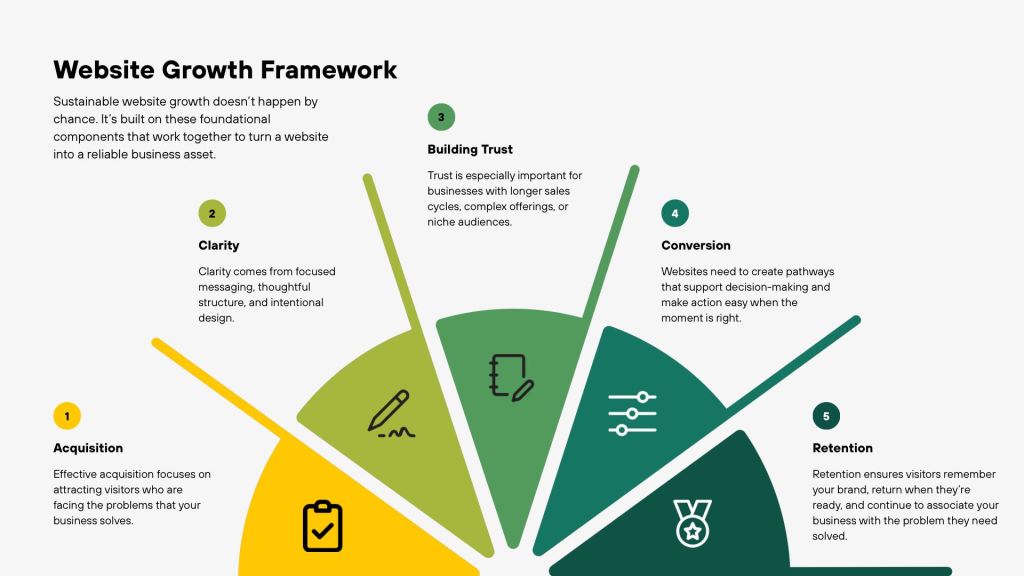
1. Acquisition: Attracting the Right Audience
Every website growth effort begins with acquisition. People need to arrive at your website in order for growth to occur, but not just any people.
Effective acquisition focuses on attracting visitors who are actively searching for the problems your business solves. This includes SEO, content, distribution, partnerships, and visibility across relevant channels. The goal is not maximum traffic, but qualified traffic—people who are most likely to engage, remember your brand, and eventually convert.
Strong acquisition ensures your website is visible at the moments that matter.
2. Clarity: Making It Immediately Understandable
Clarity is one of the most underestimated drivers of website growth.
When someone lands on your website, they should quickly understand:
- What you do
- Who it’s for
- What problems you solve
- How you’re different
If visitors are confused, growth stops—no matter how strong your acquisition strategy is.
Clarity comes from focused messaging, thoughtful structure, and intentional design. A clear website removes friction, reduces cognitive load, and helps visitors confidently decide whether your business is relevant to them.
Without clarity, even the best traffic won’t convert.
3. Building Trust: Proving You’re the Right Choice
Trust is what turns interest into belief.
Website growth depends on more than explaining what you do, it requires showing why you’re credible, capable, and worth engaging with. This is where value communication becomes critical.
Building trust on a website includes:
- Demonstrating expertise
- Sharing achievements and success stories
- Highlighting real outcomes and results
- Reinforcing reliability and professionalism
Trust is especially important for businesses with longer sales cycles, complex offerings, or niche audiences. When visitors trust you, they’re far more likely to return, engage, and choose you over competitors.
4. Conversions: Turning Interest Into Action
Conversions are where website growth becomes tangible.
A growing website is designed to guide visitors toward action, without pressure or friction. That action might be immediate or delayed, depending on the business and buying cycle.
Effective conversion foundations include:
- Clear calls to action
- Logical user journeys
- Intentional page flows
- Multiple ways to engage at different readiness levels
Website growth doesn’t assume every visitor is ready to convert right away. Instead, it creates pathways that support decision-making and make action easy when the moment is right.
5. Retention: Staying Top of Mind
Retention is often overlooked, but it’s essential to sustainable website growth.
Most visitors won’t convert on their first visit. Retention ensures they remember your brand, return when they’re ready, and continue to associate your business with the problem they need solved.
Retention is driven by:
- Consistent value
- Memorable branding
- Helpful content
- Positive user experiences
When retention is strong, your website becomes more than a destination, it becomes a resource people come back to. That repeat engagement is what allows website growth to compound over time.
How These Foundations Work Together
These five foundations are not linear. They reinforce each other.
Acquisition brings the right people in.
Clarity helps them understand they’re in the right place.
Trust convinces them you’re worth engaging with.
Conversions turn attention into action.
Retention ensures the relationship continues.
When all five foundations are in place, website growth becomes intentional, measurable, and sustainable—rather than reactive or unpredictable.
Website Growth Requires Real Human Understanding
Behind every successful website is deep understanding of people.
That means:
- Talking to existing customers
- Listening to prospects
- Learning how they describe their problems
- Reflecting their language back to them
This human insight is what transforms generic messaging into compelling messaging. It’s also what differentiates one brand from another in crowded markets.
No amount of optimization can replace understanding.
Content Is a Growth Engine When Done Right
Content plays a major role in website growth, but only when it’s strategic.
Content is not just blog posts. It’s:
- How pages are structured
- How questions are answered
- How uncertainty is reduced
- How trust is built before a sales conversation ever happens
A growing website creates content for every stage of awareness:
- Explorers at the top of the funnel
- Comparers in the middle
- Decision-makers near conversion
Ignoring any stage limits growth.
Brand Is Not Optional in Website Growth
Brand is often treated as separate from growth. In reality, it’s inseparable.
A strong brand:
- Makes decisions easier
- Reduces friction
- Builds emotional connection
- Improves recall
When someone thinks, “I need this problem solved,” the brands they remember are the brands that grow.
Website growth is not just functional, it’s emotional.
Why Website Growth Often Looks Effortless
When you see a website that feels clear, confident, and effective, it’s easy to assume it came together naturally.
It didn’t.
Behind that clarity are:
- Strategic decisions
- Rejected ideas
- Iterations
- Testing
- Refinement over time
Website growth rewards patience, consistency, and thoughtful execution. It doesn’t require perfection—but it does require intention.
Website Growth Is a Long-Term Advantage
A well-grown website doesn’t just support marketing—it supports the entire business.
It becomes:
- A trust-building asset
- A lead-generation engine
- A brand amplifier
- A decision-support tool
- A scalable foundation for future growth
This is why website growth is not a one-time project. It’s an ongoing practice.
Final Thoughts: What Website Growth Really Means
At its core, website growth is about alignment.
Alignment between:
- Business goals and website goals
- Audience needs and messaging
- Strategy and execution
- Effort and outcomes
When those elements work together, a website stops being a static presence and starts becoming something much more powerful: a system that grows with you.
That’s what real website growth looks like.
Website Growth – Frequently Asked Questions
Is website growth the same as SEO?
No. SEO is an important part of website growth, but growth also includes messaging, user experience, conversion paths, branding, retention, and continuous optimization. SEO brings people in; website growth ensures the site works once they arrive.
How long does it take for a website to grow?
Website growth is not instant, but it doesn’t have to take years either. Meaningful results depend on your goals, starting point, and consistency. Most websites see early signals of progress within weeks, with compounding impact over months.
Do I need more traffic to grow my website?
Not always. Many websites grow faster by improving engagement, conversion, and retention with the traffic they already have. Growth comes from attracting the right visitors, not just more visitors.
What are the foundations of website growth?
Website growth is built on five core foundations:
- Acquisition – attracting the right audience
- Engagement – holding attention and building interest
- Conversion – turning interest into action
- Retention & Trust – being remembered and chosen
- Optimization & Scale – improving and compounding results over time
What if my business has a long sales cycle?
Website growth is especially valuable for long sales cycles. A strong website builds familiarity, credibility, and trust over time, so when visitors are ready to buy, they already know who you are.
Do I need a full website redesign to grow?
Not necessarily. Growth often starts with clarifying goals, refining messaging, improving user journeys, and optimizing existing pages. Redesigns should support growth, not be the starting point.
How do you measure website growth?
Website growth is measured through a combination of metrics such as:
- Qualified traffic
- Engagement (time on page, return visits)
- Conversion actions
- Brand signals (direct traffic, repeat users)
- Performance improvements over time
The right metrics depend on your business goals.
Is website growth only for large companies?
No. Website growth applies to businesses of all sizes, personal brands, consultants, and organizations. The strategies scale based on your goals, resources, and audience.
Why does website growth look effortless for some brands?
Because most of the work happens behind the scenes. What looks seamless is the result of research, iteration, customer insight, testing, and long-term strategy, much like synchronized swimming, where the hardest work happens below the surface.
Where should I start if my website isn’t growing?
Start with clarity:
- What is your website’s primary goal?
- Who is it for?
- What problem does it solve?
From there, growth becomes a structured, strategic process rather than guesswork.
 Stellar Strategy