
Let’s find out why your website visitors aren’t turning into leads
In short, your website probably isn’t converting because something is breaking the experience before visitors ever take action.
It could be slow load times that test their patience, weak trust signals that create doubt, confusing navigation that makes it hard to find information, or unclear, unpersuasive messaging that doesn’t guide them toward a clear next step.
In some cases, the issue runs deeper like attracting the wrong audience, unexpected costs, or a poor mobile experience that causes users to leave almost immediately.
To fix this, start by evaluating website fundamentals. Is your home page clear and does it build trust? Is your navigation menu easy to understand, or is it cluttered with too many options? Is your content structured in a logical, intuitive way?
When a website is not converting, more often than not the issue is usability. The simpler and more intuitive your interface is, the easier it is for visitors to find what they need and move toward action. The clearer and smarter your messaging is, the bigger chances you’d have building trust into your visitors.
Reduce friction, remove confusion, and make the next step obvious, and conversions will follow.
7 Reasons That Could Cause Your Website to Not Convert
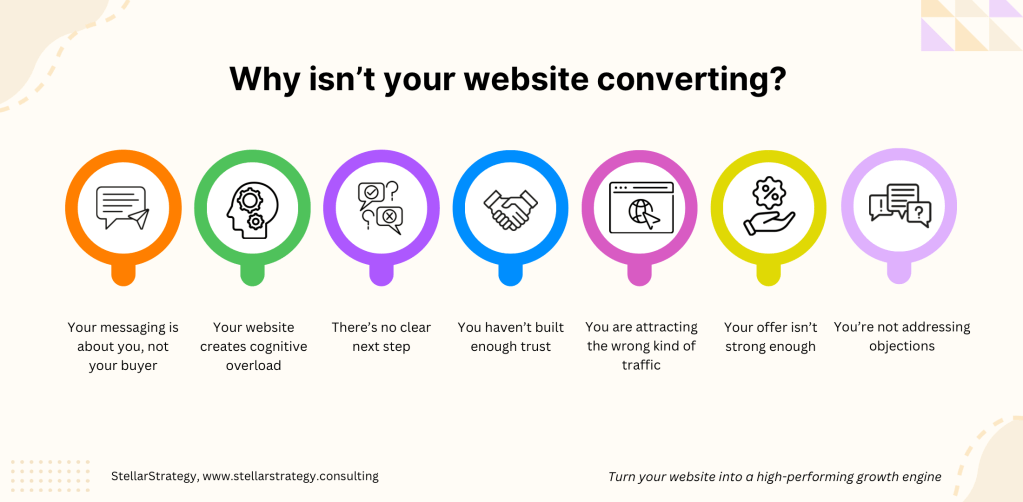
Your messaging is about you, not your buyer
I see this very often, when brands want so bad to showcase their achievements and brag about their products that they forget what their audience actually cares about. If someone lands on your website and all they see is buzzwords like “the leading provider” or “best-in class”, it would be very hard for them to assess if your product or service is what they are looking for. Your audience has a problem that they need solving. You have 5 to 8 seconds to convince them that you know their problem and you provide a solution that will translate into business growth.
If you don’t make that connection immediately, visitors won’t spend time trying to figure it out. More likely, they’ll leave and look for a solution that speaks more directly to their needs. Clear, problem-focused messaging helps visitors quickly recognize themselves in your content and understand why they should stay. When people feel understood, they’re more likely to explore further and take the next step.
Your website creates cognitive overload
I used to work with a company whose website was a nightmare to figure out. One of the reasons I didn’t see a fit to continue working with them was the lack of willingness to change on their part. Their homepage was Franshtein for conversions. There were three bright color CTAs on the navigation next to an already overloaded menu. There was a three step pop up form on the lower left side, a two step popup form on the lower right side, which was also on top of a chatbot, there were two CTAs in the hero area and a popup form in the middle of the page after 3 seconds of loading. All of these had conflicting messaging, confusing language and off brand colors. The argument on their part was that they need as many conversion points as possible in order to get leads. As I dug into the data, while the number of booked appointments was on a somewhat positive trend, the quality of leads and the actual completed appointments was so low that it was a shame they were getting so much traffic. I used a heatmapping solution to watch some visit recordings. They showed a lot of confusion! So many visitors were looking for a close option and so many visitors would just leave the page. But most importantly, I could see a pattern over time – a decline in visits, a decline in views of the booking page, a decline in quality leads, a decline in completed appointments. All of these are signs of losing the trust of your audience.
I am telling this story to show that overloading your website with conversion points is not going to help your conversions. It takes away trust, it puts off the real audience you are targeting and in the long run will turn out to be detrimental for your business.
There’s No Clear Next Step
This ties back to the above since if you have way too many conversion points, the next step is not clear. But the opposite is true too. You might not be offering enough conversion points. Or maybe those points are unclear. If you just have one Contact Us button, or you simply say Message Me, visitors might not necessarily be ready to get in touch or they don’t want to message you, they simply want to interact to get to know you better. If you are asking them to contact you before you explain clearly who you are and how you help, it will be hard to convince people to contact you. Or on the other hand, they might want to contact you but your contact options are buried and are hard to find.
You can fix the no clear next step issue by designing a strategic user journey path to easily guide your website visitors to the next steps you want them to take. Think about what you want your visitors to do next and make it easy for them to find it!
You Haven’t Built Enough Trust
This can be true for both an established and a new brand. But if visitors have any doubts about the validity of your offers and you are still working to gain their trust, low website conversions are often the results you see. Trust plays a critical role in whether someone is willing to share their information, book a call, or make a purchase.
In many cases, building trust is simply part of the natural sales process. Especially for newer brands, there’s a period where you need to consistently show value, reliability, and expertise before visitors feel comfortable taking the next step.
You cannot require or demand trust, you have to earn it. Think about all things that factor in building trust in your buyers. Provide great customer service, be open to any feedback, even negative. Listen to the negative feedback and show willingness to change and improve. Constantly work to make your products better, make sure they evolve with your customers.
Building trust takes time, but it’s essential. Without it, even the best-designed website will struggle to convert. Once you earn it, your website becomes a much more effective growth channel.
You are attracting the wrong kind of traffic
I worked with a client who came to me concerned about a significant year-over-year drop in booked demos. Their website demo conversions had decreased by about 25%, which understandably raised alarms.
When I dug deeper into the data, I discovered that their website visits were down by nearly 80% year over year.
So while conversions had declined, they hadn’t dropped nearly as much as traffic. In fact, their conversion rate had increased significantly..
This, to me, suggested that the previous year’s traffic was largely low-quality, visitors who were never a good fit for their product in the first place. They were coming to the site, but they weren’t part of the target audience, and they were unlikely to convert.
When I analyzed traffic sources, most of that low-quality traffic came from paid campaigns in Google and LinkedIn. In other words, the company had been paying to bring in visitors who weren’t aligned with their ideal buyers.
Wrong traffic means attracting people who:
- Don’t have the problem you solve
- Aren’t in your target industry or role
- Don’t have the budget or authority
- Are only researching, not buying
- Or simply aren’t a fit for your offering
Start by evaluating whether your website visibility is truly aligned with your ideal audience. Consider whether your keywords are targeting actual buyers or simply generating volume. Look at your paid campaigns and determine if they are too broad. Review your landing pages to see if they speak directly to your ideal customer, and assess whether you are targeting the right industries, roles, and company sizes. It’s also important not to wait an entire year to evaluate performance. Monitor your traffic quality consistently and look beyond simple visit numbers. Pay attention to metrics such as conversion rate by source, time on page, engagement with key pages, lead quality, and overall pipeline contribution. When you review these signals regularly, you can adjust targeting more quickly, pause underperforming campaigns, and avoid spending budget on traffic that is unlikely to convert.
Your Offer Isn’t Strong Enough
Sometimes your website isn’t converting because you haven’t clearly convinced visitors of two critical things: that they actually have a problem worth solving, and that you’re the right one to solve it. If your messaging jumps straight to high commitment conversions without first building urgency or demonstrating value, visitors have little reason to take action. From their perspective, there’s no compelling motivation, no clear risk in doing nothing and no obvious benefit in moving forward.
Many visitors arrive in an exploratory mindset. They may sense inefficiencies or challenges, but they’re not fully convinced of the impact. If your website doesn’t help them recognize the cost of their problem, whether that’s lost revenue, wasted time, missed opportunities, or operational friction, they won’t feel urgency. And if you don’t clearly show how your solution addresses that problem in a tangible way, they won’t trust that reaching out is worth their effort.
Instead of asking for immediate commitment, guide visitors through smaller steps that reinforce both points. Educational content, assessments, guides, and demos can help them better understand their challenges while showcasing your expertise. As they interact with these resources, they begin to see the gap between their current state and their desired outcome, and more importantly, how you can help close it. When you successfully demonstrate the problem and position yourself as the solution, conversions become a natural next step rather than a forced one.
You’re Not Addressing Objections
When visitors land on your website, they often have silent questions running through their minds. They may be wondering whether your solution is too expensive, whether it will work for their specific industry, what happens if it doesn’t deliver results, how long implementation will take, or whether the process will be complicated and time-consuming. These concerns don’t always get voiced, but they play a major role in decision-making.
If your website doesn’t acknowledge and address these objections, visitors tend to assume the worst. Uncertainty creates friction, and friction leads people to leave without taking action. Even highly interested prospects may hesitate if they can’t quickly find reassurance that your solution fits their needs and expectations.
To reduce this hesitation, proactively address common concerns throughout your site. This can include adding a clear FAQ section, providing pricing clarity or at least setting expectations around investment level, explaining your process step-by-step, outlining realistic timelines, and even including a “who this is not for” section to help qualify the right audience. When you openly tackle objections, you remove hidden barriers, build credibility, and make it easier for visitors to feel confident moving forward.
How to navigate website’s low conversions
If your website isn’t converting, the first step is to rely on data. You need tools in place that measure website performance, whether that’s analytics platforms, heatmapping software, session recordings, or conversion tracking. Your data always has an important story to tell, but it only becomes valuable when you take the time to interpret it. Look beyond surface-level metrics like total traffic and dig into what visitors are actually doing. Which pages are getting attention? Where are users dropping off? Which sources drive the highest-quality leads? Are certain CTAs performing better than others?
By analyzing these patterns, you can start to identify where friction exists and what might be preventing visitors from taking the next step. Low conversions rarely happen without warning. The signals are usually there in declining engagement, shorter time on page, reduced interactions, or shifts in traffic quality. When you consistently review performance and connect the numbers to user behavior, you can make informed decisions about what needs imprivements.
Most importantly, treat optimization as an ongoing process. Test changes, measure results, and refine your approach over time. Improving conversions isn’t about making one big redesign; it’s about continuously learning from your data and aligning your website experience with what your audience actually needs.
 Stellar Strategy